
The Science Behind Slime: Why Borax Solution Makes Slime Possible
If you've ever stretched a piece of slime and wondered how it can act like both a liquid and a solid at the same time, you're not alone. While slime is incredibly fun to play with, it's also a fascinating science experiment that demonstrates real chemistry in action.
In fact, every batch of slime is a tiny lesson in polymers, chemical bonds, and material science.
Let's explore the science behind slime and why a borax solution is one of the most important ingredients in creating the perfect slime texture.
Is Slime a Liquid or a Solid?
One of the most interesting things about slime is that it's neither a true liquid nor a true solid.
Scientists call slime a non-Newtonian fluid, meaning it behaves differently depending on how much force is applied to it.
For example:
- Pull slime slowly, and it stretches.
- Pull slime quickly, and it may tear.
- Let slime sit, and it slowly spreads like a liquid.
- Squeeze slime, and it acts more like a solid.
This unique behavior is what makes slime so satisfying to play with.
What Are Polymers?
At the heart of slime are molecules called polymers.
Polymers are long chains of repeating molecules connected together, almost like a long string of beads.
Many everyday items are made from polymers, including:
- Rubber
- Plastic
- Hair
- Paper
- Clothing fibers
- Glue
The glue used in slime contains polymers that can move freely past one another, which is why glue remains liquid inside the bottle.
What Does Borax Solution Do?
This is where the science gets exciting.
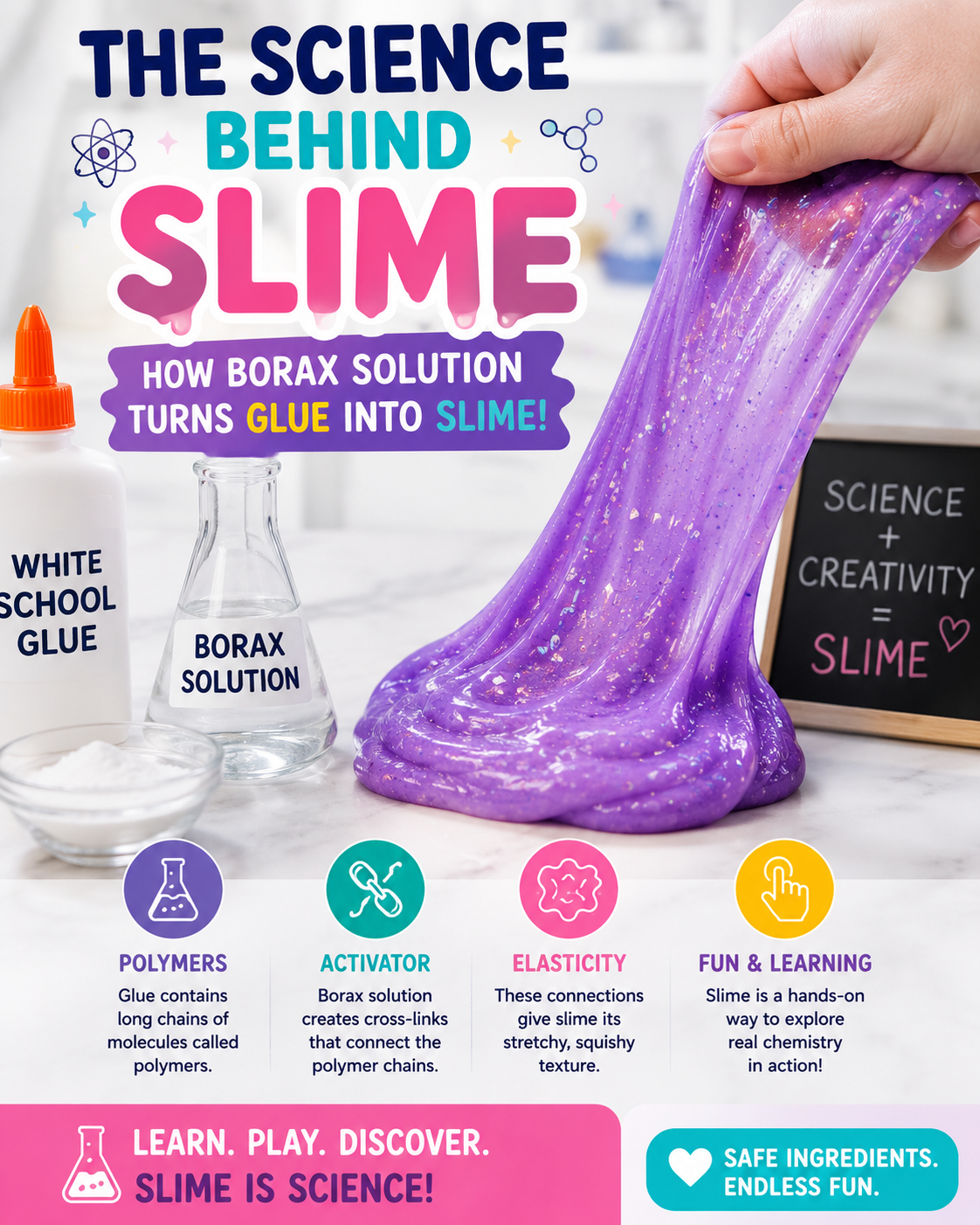
A borax solution acts as an activator for slime.
When a borax solution is mixed with glue, it creates connections between the polymer chains. Scientists call these connections cross-links.
Before activation:
- Polymer chains slide freely.
- The glue remains runny and liquid.
After activation:
- Polymer chains become linked together.
- The mixture becomes stretchy and elastic.
- Slime begins to form.
Think of the polymer chains like spaghetti noodles floating in a bowl. The borax solution creates tiny bridges between the noodles, helping them stick together while still remaining flexible.
This transformation is what gives slime its signature stretch and squish.
Why Doesn't Slime Become Hard?
A common question parents ask is why slime stays soft instead of becoming a hard plastic.
The answer is that the polymer chains are only partially connected.
The cross-links created by the borax solution allow the slime to hold together while still leaving enough flexibility for stretching, poking, and squeezing.
Finding the perfect balance between glue and activator is what helps create high-quality slime.
Different Slime Textures Use Different Science
Not all slime textures are created the same way.
Slime artists and manufacturers often adjust ingredients to create unique sensory experiences.
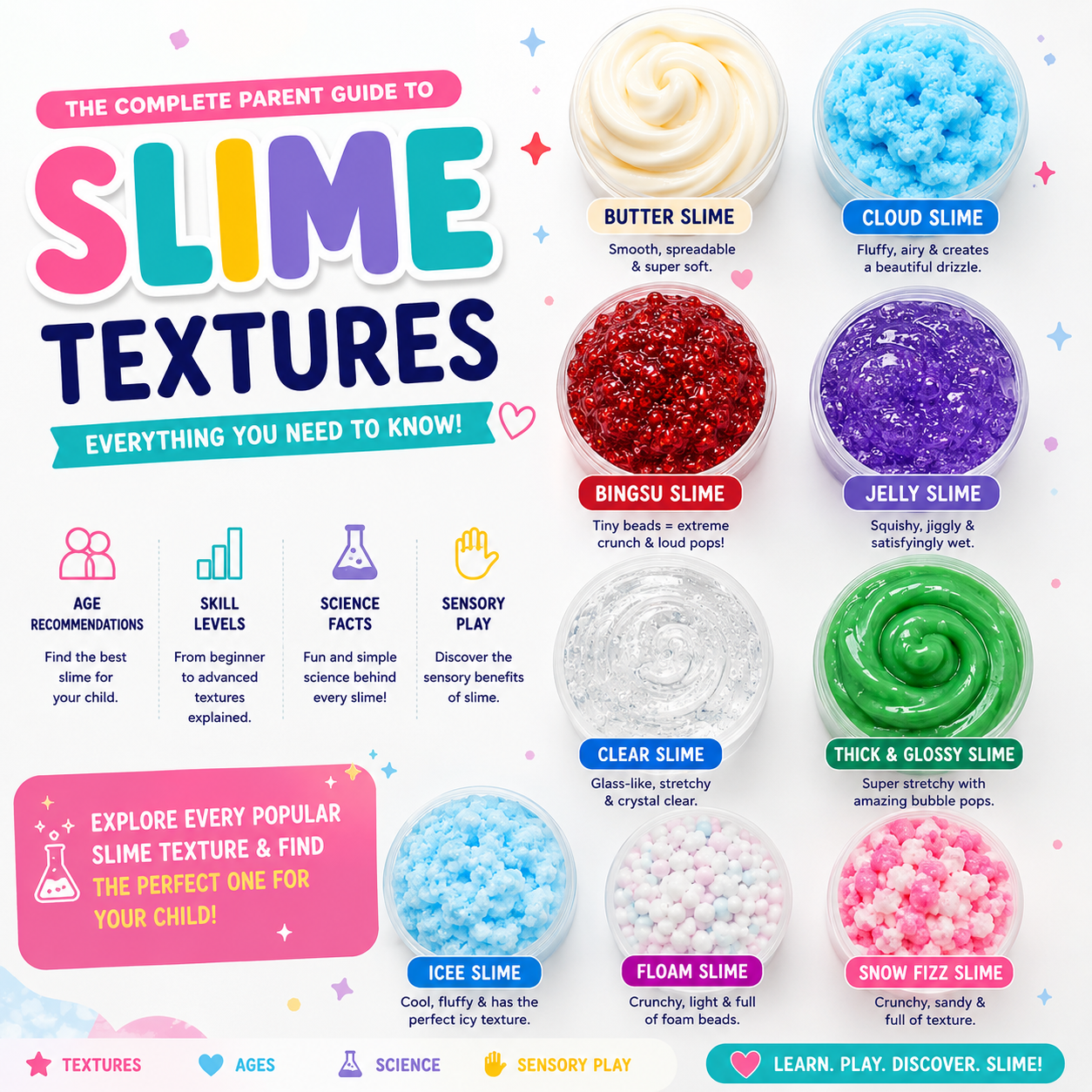
Butter Slime
Contains soft clay, which changes the structure of the slime and creates a smooth, spreadable texture.
Cloud Slime
Contains instant snow, a super-absorbent polymer that traps water and creates fluffy drizzles.
Bingsu Slime
Contains tiny plastic bingsu beads that create loud crunches and satisfying ASMR sounds.
Jelly Slime
Uses hydrated snow to create a juicy, squishy texture.
Thick and Glossy Slime
Uses a stronger polymer network that creates excellent stretches and loud bubble pops.
Each texture demonstrates different principles of chemistry, physics, and material science.
Is Borax Safe?
When used properly and in the correct amounts, borax solution is commonly used as a slime activator by slime makers around the world.
However, slime should always be handled responsibly:
- Wash hands after play.
- Do not eat slime.
- Avoid contact with eyes.
- Store slime in sealed containers.
- Follow age recommendations.
- Adult supervision is recommended for young children.
Many commercial slime companies carefully measure activator levels to ensure the slime performs well while remaining safe for sensory play.
Why Slime Is More Than Just a Toy
While children see slime as fun, scientists see it as a hands-on learning experience.
Playing with slime can introduce children to concepts such as:
- Polymers
- States of matter
- Chemical reactions
- Material science
- Sensory exploration
- Cause and effect
Without even realizing it, kids are interacting with real scientific principles every time they stretch, squeeze, drizzle, or inflate a slime.
Final Thoughts
Slime may seem simple, but there's incredible science behind every stretch and bubble pop. The combination of glue polymers and a borax activator creates a unique material that behaves unlike most substances we encounter every day.
The next time your child plays with slime, they're not just having fun—they're experiencing chemistry in action.
And that's one of the reasons slime continues to be one of the most fascinating sensory toys ever created.
Comments